

Shopping Cart
There are no more items in your cart
- Vivien Rolf
- Supplement Guides
- 0 likes
- 1154 views
- 0 comments
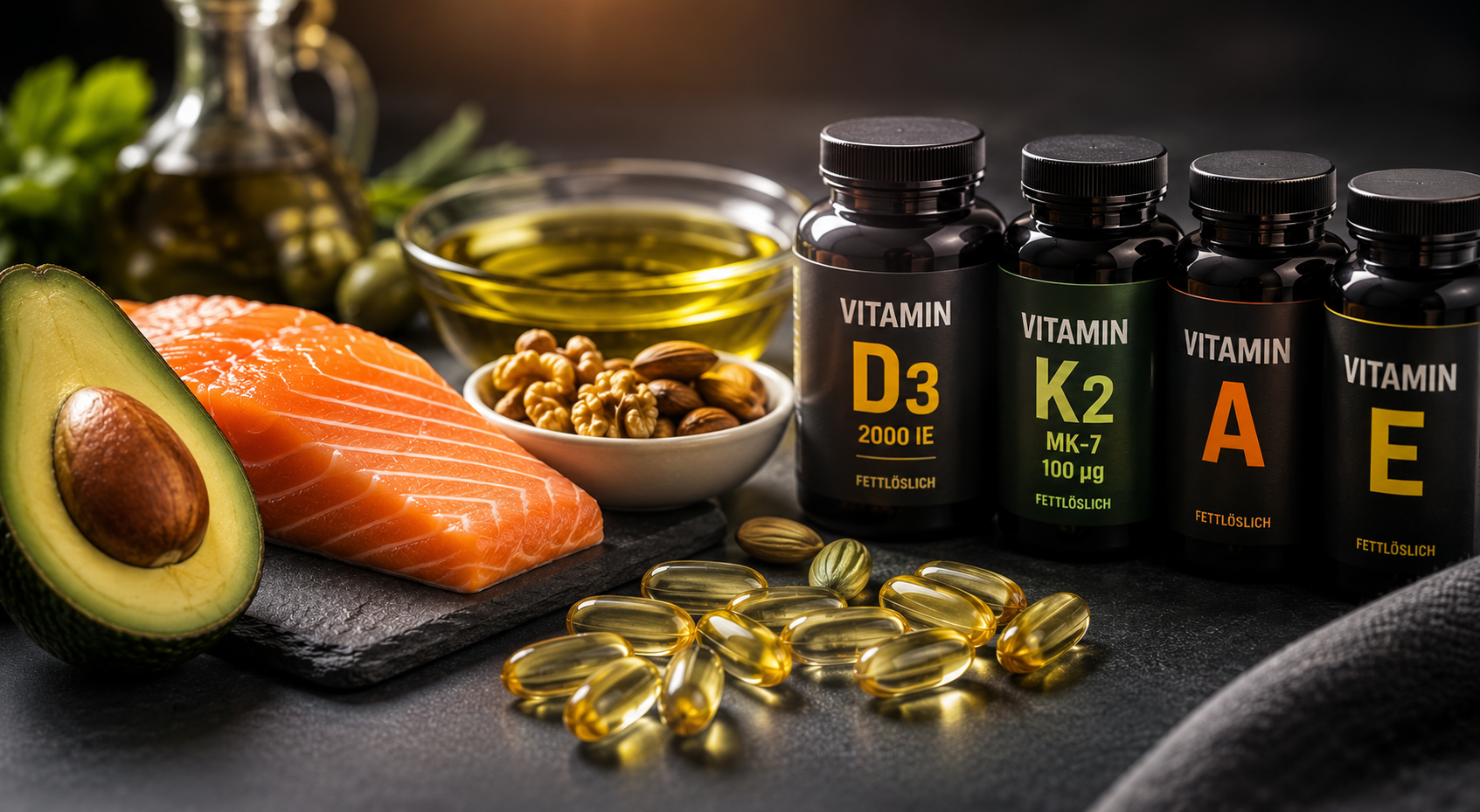
Many people simply take their vitamins in the morning with water and never think twice about it. However, the timing and especially the combination with dietary fat can make a huge difference.
Some vitamins can only be properly absorbed when fat is consumed at the same time.
This is something many people forget when taking supplements. The result:
You buy quality supplements, but your body may not absorb them efficiently.
Why Do Some Vitamins Need Fat?
Vitamins are generally divided into two groups:
- water-soluble vitamins
- fat-soluble vitamins
Fat-soluble vitamins require dietary fat as a transport medium so they can be absorbed through the intestines. Without fat, absorption can decrease significantly.
The four most important fat-soluble vitamins are:
- Vitamin A
- Vitamin D
- Vitamin E
- Vitamin K
These are often referred to as the ADEK vitamins.
Vitamin D – One of the Most Important Supplements
Vitamin D is one of the best-known fat-soluble vitamins.
Especially during autumn and winter, many people in Switzerland and other European countries have low vitamin D levels because of reduced sunlight exposure.
To improve absorption, vitamin D should ideally be taken together with a meal containing healthy fats.
Good combinations include:
- eggs
- nuts
- salmon
- cheese
- avocado
- olive oil
- fish oil or omega-3 capsules
Many high-quality vitamin D supplements already include oil as a carrier.
Vitamin A – Important for Vision, Skin, and the Immune System
Vitamin A plays an important role in:
- normal vision
- skin health
- mucous membranes
- immune function
Like vitamin D, vitamin A is also fat-soluble and should be taken together with dietary fat.
Even small amounts of fat can improve absorption significantly.
Vitamin E – The Well-Known Antioxidant
Vitamin E helps protect cells from oxidative stress and is especially popular in the fitness and sports world.
Because vitamin E is fat-soluble, it should not simply be taken on an empty stomach with water.
Absorption works much better when taken together with a regular meal.
Vitamin K – Often Underrated
Vitamin K plays an important role in:
- blood clotting
- bone metabolism
- calcium utilization
Vitamin K2 is often combined with vitamin D supplements.
Like the other ADEK vitamins, vitamin K should also be consumed with dietary fat.
Which Vitamins Are Water-Soluble?
Not all vitamins require fat.
Water-soluble vitamins include:
- Vitamin C
- B vitamins
These can generally be absorbed without dietary fat.
Does It Need to Be a Big Fatty Meal?
No.
You do not need fast food or extremely fatty meals to improve vitamin absorption.
Often, small amounts of healthy fats are enough, for example:
- a teaspoon of olive oil
- a handful of nuts
- some cheese
- an egg
- avocado
That is usually enough to support the absorption of fat-soluble vitamins.
Why Many People Take Supplements Incorrectly
One common mistake:
Taking vitamins in the morning on an empty stomach together with coffee.
Fat-soluble vitamins are often absorbed less efficiently this way.
If you invest in quality supplements, it also makes sense to pay attention to proper intake. Even the best products are less effective when bioavailability is poor.
Can Fat-Soluble Vitamins Be Overdosed?
Yes – and this is why excessive dosing should be avoided.
Unlike water-soluble vitamins, fat-soluble vitamins can be stored in the body. This means overdosing is theoretically possible, especially with vitamin A and vitamin D.
More is not always better.
Conclusion: Fat Makes a Real Difference for Many Vitamins
Vitamins A, D, E, and K require dietary fat for optimal absorption.
Anyone who wants to get the most out of their supplements should pay attention to proper intake and avoid taking fat-soluble vitamins on an empty stomach with only water.
Even small amounts of healthy fats can improve absorption and help your body benefit more effectively from these vitamins.
Especially in fitness and sports, this can make a long-term difference for recovery, immune function, and overall health.
The images used in this article were created with the help of artificial intelligence (AI). The people shown are entirely fictional and do not represent real athletes.
Of course, we would prefer to show real athletes and sports professionals. However, professional sports photography is often extremely expensive and can quickly cost several hundred Swiss francs per image. To continue providing free content, we sometimes use AI-generated illustrations instead.
Comments (0)