Mixed Martial Arts (MMA) is one of the most demanding combat sports in the world. It combines striking, kicking, wrestling, takedowns and ground fighting into one discipline. Because of this complexity, many MMA gyms prefer new members to have previous experience in another martial art.
If you have never trained before, you may be advised to spend several months learning boxing, kickboxing, Muay Thai, wrestling or Brazilian Jiu-Jitsu before joining an MMA class.
Why Do Many MMA Gyms Require Experience?
1. Strong Fundamentals Are Essential
MMA is not a single martial art—it is a combination of several disciplines.
Athletes with experience in boxing or kickboxing usually already possess important skills such as:
- Proper punching technique
- Footwork
- Defensive movement
- Distance control
- Coordination
These fundamentals make learning MMA much easier.
2. Safety Comes First
Many MMA classes include partner drills, clinch work, takedowns and sparring.
Beginners often do not yet know:
- how to fall safely,
- how to control their strikes,
- how to protect their training partner,
- when to tap out during a submission.
Without these basic skills, the risk of injury increases for everyone involved.
3. Training Is Often Fast-Paced
Many MMA gyms have recreational members and competitive fighters training together.
In advanced classes, coaches cannot spend every session teaching basic techniques from the beginning. For this reason, many gyms expect students to arrive with a certain level of experience so that the entire group can train efficiently.
4. Progress Is Faster
Training one martial art for six to twelve months before starting MMA helps develop:
- Better conditioning
- Proper technique
- Balance
- Timing
- Body awareness
- Confidence
As a result, the transition into MMA is usually much smoother.
Our Recommendation
We also recommend gaining experience in a martial art such as boxing, kickboxing, Muay Thai, Brazilian Jiu-Jitsu or wrestling before starting MMA.
The reason is simple. Many MMA classes assume that students already understand the fundamentals. Complete beginners first need to learn basic movement, striking, defensive skills or ground techniques.
This means coaches often have to spend extra time with individual beginners while the rest of the class waits. As a result, the training session becomes less efficient for everyone.
With six to twelve months of previous experience, new students usually adapt much faster, keep up with the class more easily and contribute to a smoother and safer training environment.
Which Martial Art Is Best Before MMA?
Boxing
Excellent for punching technique, footwork and distance management.
Kickboxing or Muay Thai
Perfect for kicks, knees and clinch work.
Brazilian Jiu-Jitsu (BJJ)
The best foundation for ground fighting and submissions.
Wrestling
Ideal for takedowns, balance and controlling opponents.
Does This Mean Beginners Can't Train MMA?
Not at all.
Many modern MMA gyms offer beginner-specific classes where students learn the fundamentals step by step before moving on to more advanced training or sparring.
However, performance-oriented gyms often expect previous experience. It is always worth asking about the requirements before signing up.
Conclusion
MMA is an exciting and highly technical sport, but it is also one of the most demanding martial arts.
Many gyms therefore recommend or require previous experience in boxing, kickboxing, Muay Thai, Brazilian Jiu-Jitsu or wrestling before joining regular MMA classes.
Building a solid foundation first improves safety, speeds up learning and helps create a better training experience for everyone involved.
Image Disclaimer:
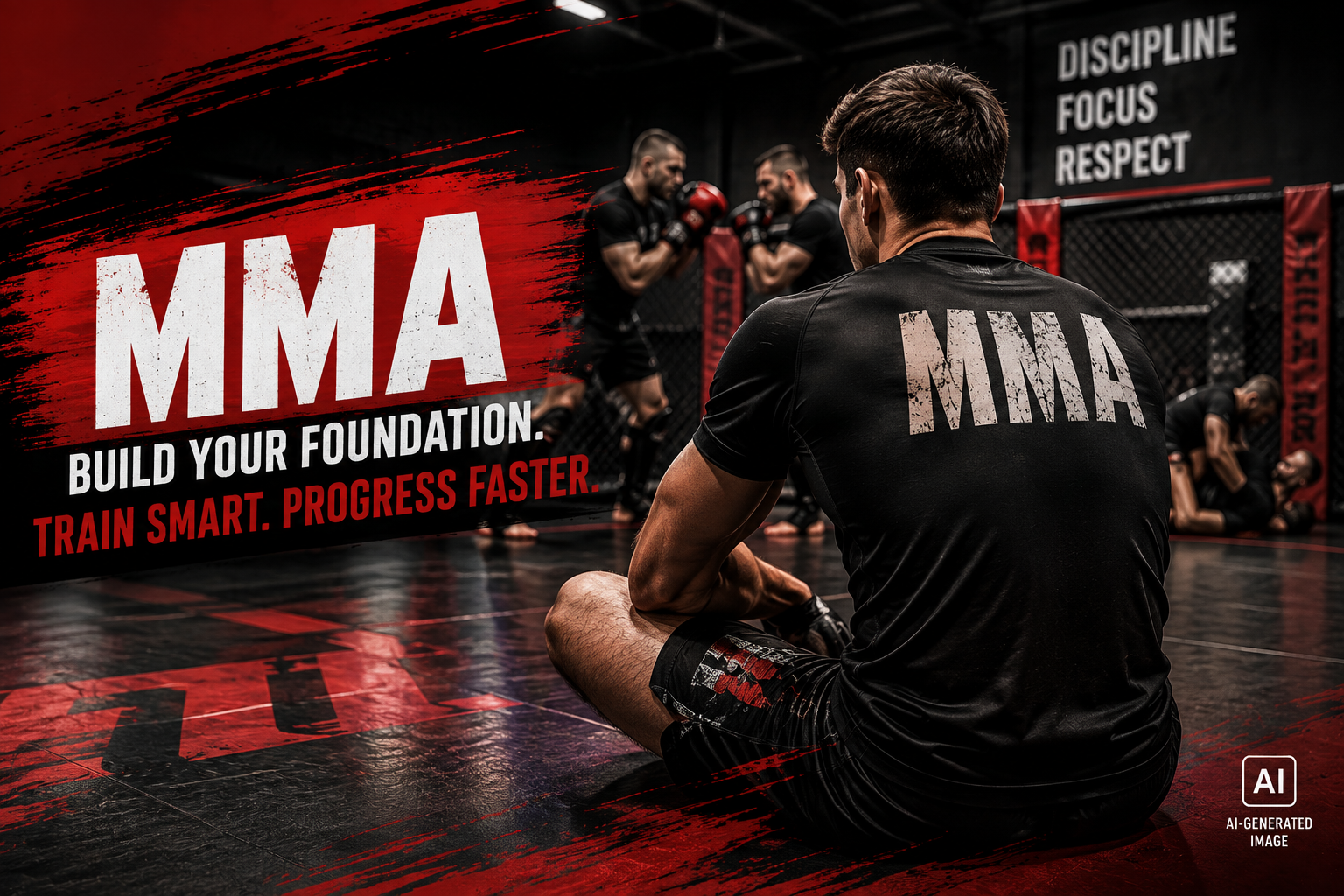
The images used in this article were created with the help of artificial intelligence (AI). The people shown are entirely fictional and do not represent real athletes.
We would naturally prefer to use photographs of real boxers and athletes. However, professional sports photography is often subject to expensive licensing fees that can quickly reach several hundred Swiss francs per image. To continue providing free content, we occasionally use AI-generated illustrations instead.







Comments (0)